Mission Advisors CEO Dana McGinnis at MidStream Texas Conference
[vc_row][vc_column][vc_video link=”https://youtu.be/RyyhoRJ2J30″][/vc_column][/vc_row]
[vc_row][vc_column][vc_video link=”https://youtu.be/RyyhoRJ2J30″][/vc_column][/vc_row]
“OPEC’s bad dream only deepens next year, when Permian producers expect to iron out distribution snags that will add three pipelines and as much as 2 million barrels of oil a day.” Read more. . . Source: Bloomberg Business, Nov. 21, 2018
November 8, 2018
Dear Partners,
Oil prices reversed trend after many weeks of climbing. During October, both Saudi Arabia and Russia increased production to levels that the market believed would compensate for any potential shortages created by U.S. sanctions on Iran. The administration deserves some credit for pushing for lower oil prices, but the market action we felt in October was difficult, to say the least.
For some time, we have been experiencing normal buildup of market optimism, on a number of fronts. There has been euphoria about the growing economy and historically low unemployment in America. The run-up in oil prices was built on the realization that worldwide investment in the energy industry has not been sufficient to replace current levels of production constantly being reduced by natural depletion. This much is true, but inventory levels do fluctuate with market sentiment. We believe the current market correction in stocks, which continues in November, should soon run its course, and the current strong economic statistics warrant positive sentiment.
To offer some perspective on our strategy, the volume growth we identified in the Permian Basin as early as 2014 continues its momentum. Recent price discounts in the Delaware Basin have been as high as $15 per barrel below stated WTI because of take-away constraints. It is public knowledge that sufficient extra capacity will be in place by the end of 2019 for all producers to add major volumes and the easy transport should diminish discounts. We think shortages of take-away capacity could happen periodically as volumes continue to rise.
New volumes from the Permian may risk putting pressure on prices in the future. Consequently, U.S. shale production would become the worldwide swing producer and could earn a growing share of global business. We feel we are positioned to benefit from volume growth for years to come.
Dana McGinnis & Mission Advisors
October 9, 2018
Dear Partners,
Oil prices have been pushing higher over the past few weeks because of a tightening of supply and looming sanctions on Iran’s oil output. It is hard to say where prices might go in the near-term, but from an economic point of view that does take into consideration a modest amount of political influence, an oil price in the $60-80/bbl range seems like it might be the sweet spot, for U.S producers where our interests lie.
In the long run, economics will rule prices as long as the U.S. can continue to increase production and export product. We think that time will be measured in decades. The U.S. is in the best overall position worldwide to meet most of any rising demand with new production or meet the needs of flat worldwide demand created by natural depletion. Only if demand rises quickly will there be a problem meeting the demand largely from the U.S. We have said many times that in order to even maintain flat production, new drilling must occur and maintenance capital must be spent. Few countries have that capital now. At current prices, or lower, onshore U.S. is the best place to secure new production at a profit.
Bear in mind though, with prices above $60 and stable, the Gulf of Mexico and certain other offshore areas can be very profitable and prolific. Long lead times with high and stable prices though will be required. For the moment, the wild card is Iranian production and whether or not they can get around sanctions. We doubt this will happen. We think current U.S. policies are aimed at creating a more reasonable Iran which can add to the world economy, not cause trouble. A stable Iran can and will increase production and put pressure on prices. No complaints here.
We firmly believe that the best place to be is the Permian Basin where prices are good and volumes are rising. Investors may hear that expression in the future, over and over and it might sound boring. The cash flow will not be boring.
Yours sincerely, Dana McGinnis & Mission Advisors
September 5, 2018
Dear Partners,
The U. S. oil and gas markets had a constructive month in August. Oil prices were firm, backed by a steady draw down of inventories and continued growth in worldwide demand. Economic and political conditions in many oil producing countries are chaotic. Looming sanctions in Iran add to the uncertainty of supplies. Prices are higher because demand is higher. Lost production, whether by depletion or by sanctions, must be replaced.
Over the past few weeks, the MLP market prices have improved. Numerous MLP partnerships have clarified capital structures making them more transparent to investors. Others have secured private equity investments to help fund the massive infrastructure projects that are needed to handle new production.
In the meantime, gas volumes are growing in areas such as the Marcellus and the Haynesville, while oil production is growing in the Bakken. Foreign offshore areas including West Africa, Guyana, and Brazil are also showing some life with higher oil prices stable. Much of the new U.S. supply of gas is flowing to export markets via LNG from both the East Coast and the Gulf Coast.
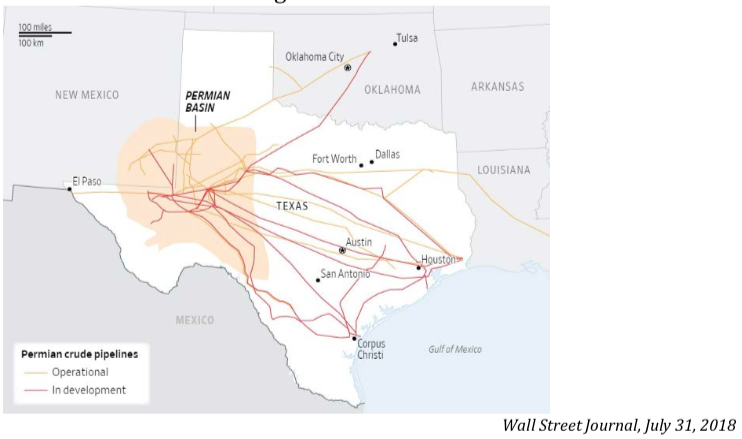
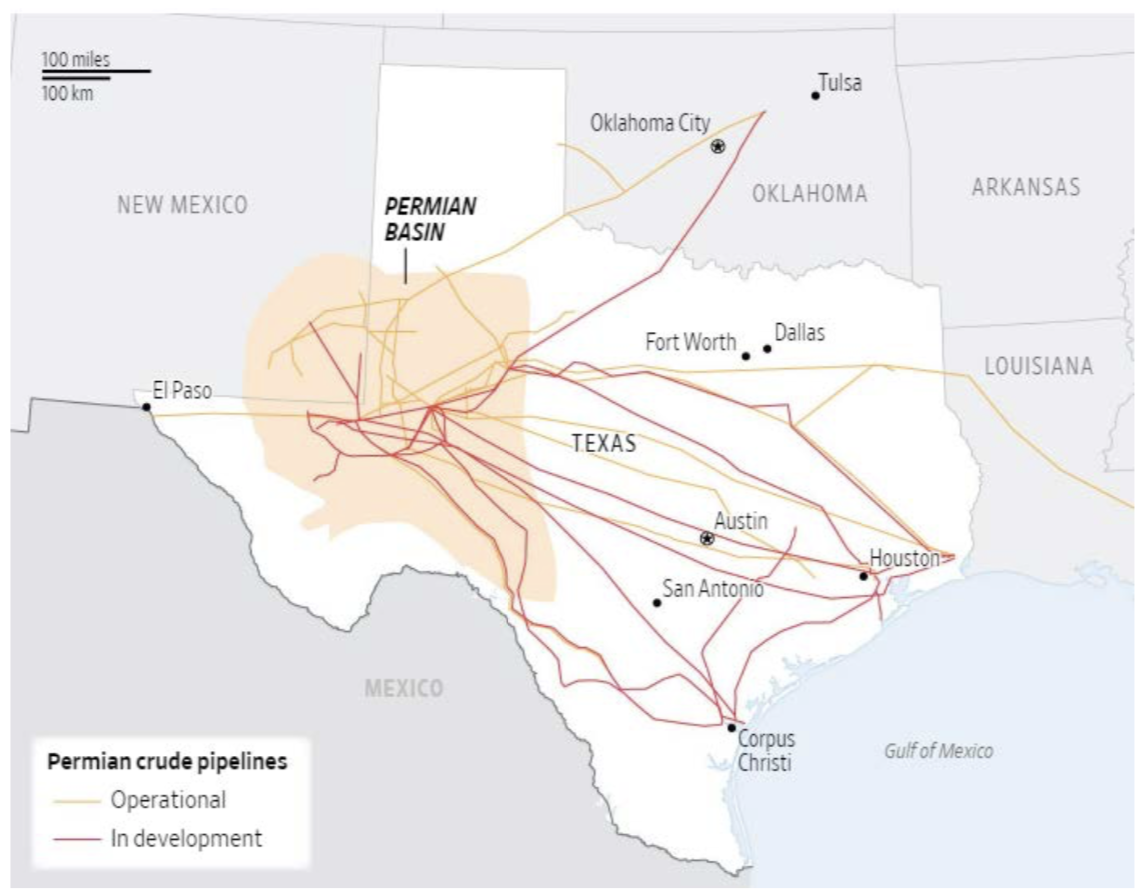
The real growth in domestic production, however, continues to be focused in the Permian Basin, where half of the working rigs are located. As I noted in last month’s newsletter, a potential future take-away shortage might develop as production growth could outpace pipeline take-away capacity. However, we think that even if production in the Permian doubles in five years, take-away capacity should be able to increase to handle the growth in production. This is demonstrated in the map from last month’s newsletter and shown again below:
Another issue has been brought further into the light recently – the large and increasing amount of produced water from the Delaware side of the Permian Basin. The energy industry has long known that the amount of produced water would be a major issue and the key players have made allowances for how to handle it. For those who do not have a plan, it will be a major problem. To demonstrate the scale of what is to come, imagine each well in the Delaware that produces 1000 bbl./day of oil will also produce 5000 bbl./day of water. It is a problem that will reduce profit margins for many producers.
Taking a step back to look at the policy/geopolitical outlook, U.S. policy decisions seem well grounded in both economic and common sense terms. Many positive developments are largely ignored by the press. I see the current hardball approach as aimed not at producing a long term trade war, but as a tactic meant to create a much better world and much more free trade for everyone. Those who deal with a rogue Iran as it is now (an indisputable bad actor for more than a generation) and complain of U.S. interference should imagine how much business they might do with a more reasonable government in place in Iran. This appears to me to be the aim of U. S. policy. Nobody wins a trade war and we do not believe the U.S. wants one. The administration seems to want trade practices that match the modern world. Many of the trade practices put in place after WWII are no longer in the best interest of the U.S. Now allies and enemies alike are facing a very different America.
U. S. markets are optimistic. Energy markets are stable. Stocks are at all-time highs. The U.S. economy is growing well and unemployment is at record lows for all groups of people. In the current economic scenario, we are confident that our energy strategy is the right one for our investors.
Yours Truly,
Dana McGinnis &
Mission Advisors
August 16, 2018
Dear Partners,
This map shows the number of pipelines that are proposed to be built in the Permian Basin, to handle the expected increase in production in coming years. Bear in mind that the Permian Basin constitutes the largest oilfield in the world now and the proposed capacity increase of these pipelines will double the production rates. While it is true that not all of the pipelines may be constructed, it will still be the largest production increase anywhere in the world, even if only a few of them are built.
The world’s oil supply and demand situation remains complicated – as are global energy politics. The main thing that energy investors need to remember is that large new supplies are coming from the Permian Basin, which will meet new demand (though not necessarily all) and continue to displace high cost producing areas.
Yours Truly,
Dana McGinnis &
Mission Advisors
July 9, 2018
Dear Partners,
The oil markets and our holdings were stronger than expected in June after the big run up in May. Geopolitics and some technical issues get the credit. The U.S. government has re-imposed strict sanctions on Iran over its nuclear program and its support of terrorists groups all over the Middle East. Furthermore, the U.S. has threatened to close the U.S. market and exchange capabilities to any country that does not comply. No country can afford to disregard this threat.
On the technical side, fighting in Libya has limited their ability to export the amount of oil that is expected of them by OPEC. Venezuelan production continues to decline due to the corruption of the government and the lack of capital or foreign exchange to sustain the infrastructure. There was a fire in the tar sands of Canada that will likely take 360,000 barrels of production off the market for the month of July. Lastly, production in the Permian is beginning to outpace take-away capacity and this will soon limit the amount of oil that can reach the market from the area. New pipelines are under construction but constraints will be in place for a year or more.
Taken together, these events have reduced the amount of oil available at the same time that OPEC has reduced production – just when demand is at a seasonal high. Demand is rising in general worldwide on top of these short term current issues so oil prices are going up. It is hard to say how long this situation will last but there are few options that will help bring prices down in the near term.
The fundamentals of the fossil fuel markets for the moment are firm and the geopolitical situation, while tense, is also positive for energy prices.
Please feel free to call with any questions.
Yours Truly,
Dana McGinnis &
Mission Advisors
June 11, 2018
Dear Partners,
It is one thing to write about why we select certain holdings for our fund. It is another thing altogether to see our convictions come true in as dramatic a fashion as you have seen this year. I am pleased to have performed well for our partners over the years, particularly during this last month. I will add that the Permian Basin’s dominance driving recent performance is far from over. Currently the Permian produces about 30% of the 10 million barrels of oil the US produces a year. We believe in future years that percentage will rise to almost 50%. The Fund is well positioned with Permian centric assets that we feel should continue to perform.
We do caution partners that there are reasons to expect consolidation of these gains during the next few months, at current levels or even slightly lower, because of take away capacity constraints and labor shortages in West Texas. Major companies are working as hard and as fast as they can to build pipelines and processing capacity to handle current production — and even higher production levels in the future. As these major new capacity additions near completion, we believe our portfolio assets will continue to appreciate.
Please feel free to contact us for further details or with any questions.
Sincerely,
Dana McGinnis
And the Mission Advisors Team
May 11, 2018
Dear Partners,
The oil markets and the energy business came to life over the last few weeks spurred by steadily falling inventories, continued production restrictions by key OPEC members, and rising tensions over the Iran deal. Most energy indices performed well in April and May is off to a good start.
At the moment, oil prices are around $70 a barrel. As I have said before, we are not in the business of predicting oil prices, but we have had a bullish bias for at least a year. Our optimism is buoyed by many factors including what we see in the global markets as well as the flourishing Permian Basin where we have taken great interest. We remain convinced that the Permian Basin is the place to be if you want to make money in energy.
We all recall the period from 2014-2016, when oil prices dropped dramatically, breaking the 20+ year reign of market manipulation by OPEC. The recovery we are seeing is due to the ingenuity of U.S. free market forces and the expertise of the U.S. energy industry. We have developed the formidable ability to extract massive amounts of oil and gas from shale formations and bring new supplies to market at a profit.
Presently, take-away capacity constraints in the Permian are putting pressure on WTI, which is beginning to sell at a discount to Cushing prices. We believe that as West Texas pipelines come on stream later this year, Permian volumes will begin to put pressure on worldwide prices – and WTI discounts should shrink again.
As for the sanctions on Iran affecting the world energy markets, we think the effect will be minimal except for Iran where they will certainly sting.
We hope all is well with you and encourage you to call us with any questions.
Sincerely,
Dana McGinnis &
Mission Advisors
April 8, 2018
Dear Partners,
Processing of K-1s has taken longer than expected but we hope to get K-1s out to you ASAP. For the time being, we can supply a rough estimate that there should be little in the way of income or realized capital gains or losses for 2017. We do expect that there will be some depreciation deductions. Overall we are estimating zero in the way of taxable income.
Turning to the market and the portfolio, the Fund had a correction last month. The energy sector and general markets had a much bigger one. Markets across the board are now in a correction, mostly over the tough trade talk coming out of the White House. There have been some tariffs imposed on China but they are still minor and it is rumored that there are behind-the-scene talks to reach a non- confrontational settlement. No one wins a trade war, but the Administration has a point that much of the trade with China and others is too one sided and there are likely ways to improve them.
Passing a tax bill, which was very good, is not enough. The economy is in very good shape now after only a year partially because of the tax cuts, but also because of a series of little talked about rollbacks of burdensome government regulations. These regulatory revisions could help create an even stronger economy and jobs market that could last years and years.
Despite the current market correction, the US energy markets are in pretty good condition. Prices are higher. Most companies have greatly reduced costs and are focused and lean. Prices are not high enough yet for some areas to return to active exploration but activity in the Permian continues. The U.S. is starting to export increasing volumes of petroleum products, helping the world keep prices for energy low. This is a boon to all economies. The Permian has the lowest costs of any area in the world outside the Middle East and is doing extremely well in the current environment. Remember that competitive production from the Middle East has very low cost but is governed by country budgets that need revenues not profits.
Prices around $60 for oil are high enough to be extremely lucrative for Permian operators. They are not high enough to bring much competition from other areas such as the Bakken or the Eagle Ford, or from offshore wells. If OPEC producing countries were to try to increase production in the near future, prices would again decline, in our opinion. This is a beneficial scenario for the U.S. and will likely last until rising Permian production can no longer supply the bulk of slowly rising worldwide demand.
We think the Permian Basin and its producers will continue to rise in prominence and importance. With the portfolio tactically committed to the area, we expect our investors will continue to profit.
Best regards,
Dana McGinnis and the team at
Mission Advisors