
Portfolio Manager’s Update – June 2019

The oil markets have taken on a more positive tone in the last month as inventories are experiencing large drawdowns, OPEC has decided to restrict production through the end of the year, and tensions continue to mount around the Strait of Hormuz.

We feel this bodes well for oil prices to remain around the $60 mark for WTI for an extended time. We have long used $60 oil as the basis of most of our estimates and projections, and for overall oil geopolitics. $60 prices provide ample profits for producers in the Permian Basin, and keep pressure on most other producers all over the world – including the Saudis.

We look forward to earnings season near month end, and hope you are enjoying a good summer.

Portfolio Manager’s Update – May 2019

Over the last month, many factors have affected the general markets and the energy markets. Among these are trade wars, immigration issues and worries about slower growth. They have put pressure on the markets and especially on the oil and gas market that is concerned about future demand and rising supplies. The energy sector has come down with the general market but has not recovered as well as the general market has.

We think that the trade issues will eventually be resolved, especially the most important trade issues with China. Other problems, such as the dispute with Iran might continue, as might the continued problems in Venezuela. In the long run, if the trade disputes with China reach some type of reasonable resolution, the markets will likely ignore other issues and begin to rise – oil markets included.

Portfolio Manager’s Update – April 2019

The oil market scenario played out much as we anticipated in last month’s letter. As prices rose in the early part of the month, so did the market. The market decreased in the second half as supplies came on the market, largely from the Permian Basin.

OPEC will meet next month and decide whether or not to extend production cuts. It appears that the recent price decline will make it easier for OPEC to maintain cuts a little longer in order to keep prices higher. It is actually a good plan for OPEC. After all, Saudi Arabia is thought to require $80 oil (vs. $70 today) to balance their budget needs. So far, few areas outside the Permian Basin are actively seeking or producing new supplies. Worldwide demand continues to rise steadily so we continue to anticipate that prices will stay firm until large volumes come online later this year from the Permian. Thereafter, prices should moderate. We expect prices to be low enough in the Middle East to cause unease for the Saudis. Meanwhile, WTI (West Texas Intermediate) should be set high enough for Permian producers to supply almost all the marginal supply needed for many years.

Portfolio Manager’s Update – March 2019

The oil markets continued to firm over the past month with WTI prices back above $60/bbl. We have regularly used $60 as a long term target for domestic oil prices and we believe that is the optimum price to balance world oil supply/demand, and to for the Permian Basin to remain the most important source of production.

The key issues driving oil prices have been the OPEC strategy to cut slightly the supply from member states and from Russia as a partner, sanctions on Iranian production, problems in Libya, and the economic disaster of socialist Venezuela.

We believe that over the next six months all these players will simply wait to see what develops. OPEC will wait until the second half of the year to decide whether or not to continue the cuts. Most other producers and operators will also probably wait and watch prices until new volumes begin to flow out of the Permian later this year. Should this scenario play out, it would mean that prices will continue to firm in the near term. Toward the end of the year when Permian volumes do appear, if prices stay at current prices or higher, producers or operators that have the capacity and the capital will begin again to source new crude. If prices soften as we expect with new Texas production, those plans for alternative regions will be put off again and the Permian will dominate the oil agenda for the next several years. The Fund is positioned to profit in this most likely case.

Texas Pacific Land Trust, is performing very well on its own profit news and despite the news of a looming proxy battle over the Trustee seat vacated by the death of longtime chairman Maurice Meyer. As one of the largest shareholders, we believe in what the management has done historically, and what they will do in the future. Concerning this current issue, we believe the management will continue to act in the best interest of the shareholders. We will follow up with more detailed communications to our investors throughout the process.

Portfolio Manager’s Update – February 2019

The price of West Texas Intermediate (WTI) is now hovering around $57/bbl., not far from our long price target of $60. We have long said that a price of $60 would satisfy most of the Permian producers and leave most other productive areas that are able to produce large volumes of oil struggling for profitability.

A $60 WTI price contrasts to nearly $70 for Brent crude coming out to the North Sea. While $70 is plenty to offset lifting costs in the Middle East and is quite profitable for Russia because of the authoritarian government and low local costs, it is not quite high enough to take pressure off the Saudis’ budget needs.  Pipeline connections to be completed in the Permian this year will bring new volumes and profits for our portfolio companies and keep some pressure on prices. This scenario is the sweet one for the Permian.

Portfolio Manager’s Review of 2018

January 9, 2019:  Review of 2018
2018 started with the energy markets still recovering from the shocks of the massive price declines of 2014 and 2015 and OPEC attempts to nurse prices higher. Those OPEC maneuvers included first an increase in production by the Saudis in an effort to punish rivals and later a concerted efforts to cut production to sop up excess supplies and let expected rising demand worldwide push prices higher. This strategy did work but also encouraged a creative and persistent US industry to lower costs further. Prices in 2018 not only recovered but began to get frothy as Brent prices exceeded $80 and WTI got over $70. Talk was rampant of $100 oil in the summer because of potential shortages as US tightened sanctions on Iran. What we should have remembered then, as we all did when prices started down, is the volumes that will come from Permian Basin.

As prices rose in 2018, the US administration began complaining of the high prices to our “ally” the Saudis. Obligingly, they increased production. But so did the Russians (unasked, and because they could) and the US, also because we could. Prices fell immediately. The differences in the major producers (US, Russia, Saudi Arabia) is that the Russians can live with the lower price. For the US, it is still marginally profitable now and individual companies make their own decisions based on economics. At current prices, (around $60 Brent) the Saudis, however, cannot live within their budget needs. So, at the urging of the Saudis, OPEC agreed, again, to cut production. Those cuts will likely work again to raise prices…at least for a while.

Before that situation, prices of oil plunged with the benchmark WTI (West Texas Intermediate) falling from $70 to $42 on Christmas Day (with WTI discounts because of take-away constraints even lower). That was the cause for all of the pain in the industry and for oil investors in 2018. The decline was swift and brutal.

General markets were also hit hard. Concerns arose about rising interest rates and trade wars raged. The result was the worst market performance in the last ten years. Despite all that, we believe that the market has a good chance to regain its footing in 2019. The economy is still quite strong and the Fed now seems ready to suspend further rate moves. In the end, we think the oil markets will stabilize as well.

Strategic Issues in the Way Forward
As the volatility of 2018 recedes and the factors that could affect the markets in 2019 are put in place for the oil markets, there will be certain markers to watch. Superseding any of those factors concerning the oil business, however, will be major economic issues such as current trade negotiations with China, actions from the Fed,
and discord in the US Congress. We believe the USA and China will reach a reasonable trade agreement this year. It will not be perfect but should be better by far than dealing with China as it acted over the past several decades. What we mean by that is that China has ignored or broken trade rules and coerced technology transfers for trade. China will likely become a better trading partner to the world after a deal is reached… for at least a while. They are unlikely to go far enough with trade agreements to loosen the Communists Party’s grip on power, but in order to
get any agreement from the US, they will have to give enough.

The Fed will probably refrain from raising rates in 2019 as there is little evidence to support further tightening, just as we believe there was none to support the increase in December. Lastly, it appears that Congress will again be a mess and will likely act foolishly and do little in the best interest of the country. No news here. We all hope this can change. We expect the markets to largely ignore Congress after a trade deal has been reached with China.

The Energy Market
The price of oil is all important, but it is near impossible to predict. The price has to be high enough to make finding new supplies profitable, or the volume of this key commodity will begin to dry up. To be sure, many places in the Middle East can produce oil and gas at negligible prices, but they also have large budget needs and luxury lifestyles that equate to finding costs in the real world. So, the price of oil must at least average over time a price high enough to stimulate production in the real world to satisfy demand. In the dream world of the Saudis, that price would also be high enough for them to balance their budget. The actual markets may not provide both at the same time.

The weakest link in this equation is the Saudi budget. In the current environment, they have less ability to control their own future through price manipulation. They will feel the pressure of low or even moderate prices first. The US will be second. Russia may not bother at current prices as long as they can sell their oil and gas. They may be subject to sanctions, however, for their persistent effrontery to world peace. In the meantime, they are greatly helped by the fact that their costs are in the weak ruble while sales are in dollars. No other producers really matter in this little dance.

Things to watch in 2019
The things to watch this year are 1) OPEC production cuts, 2) Permian production volumes and new take-away capacity, and 3) Worldwide oil demand numbers.

OPEC has announced that they will collectively cut production by 1.2 million bbl./day beginning in January in order to raise prices. Prices are indeed higher already in the New Year. The indications are that the cutting is taking place and there are even pledges from the Saudis that they may cut even more than they promised. OPEC has every reason to make these cuts to keep prices up, but many members are prone to cheating and their reporting is unreliable. Any differences will eventually show up if cheating is occurring through demonstrable supply surpluses. Nonetheless, we can expect prices to rise through the first half of the year.

Permian production will rise quickly as soon as expected pipeline capacity is finished. It is anticipated that 2mm bbl. /day of new take-away capacity will be in place by year end 2019. In two years, we expect that capacity will be full. By the end of 2022, there could be another 2 mm bbl. of take away in the Permian and production could rise by 4mm bbl. /day in five year’ time.

As far as expected demand, the International Energy Association (IEA) thinks worldwide demand for oil will increase by 1.4MM bbl. /day next year and could increase by more than 6 million bbl. /day in five years’ time. We have just outlined a lot of moving parts for the price of oil and it makes little sense to guess the price. That said, the most likely scenario seems to be that prices will be high enough to keep the Permian production profitable and demand most likely will be high enough to absorb at least the four million more barrels a day that the Permian could produce over five years. There could even be some room in demand for the Saudis and the Russians to add a little more production over time at prices not much higher than $60-65. At those levels, there would be little likelihood of large volumes coming from anywhere else.

Conclusion
All of the three major points we mention must be watched carefully, even if our conservative conclusions mean that oil prices move only modestly higher this year and for several years. With that expectation, the only place that will see any significant volume growth will be the Permian Basin. We think energy investors must mostly look there for good returns. As for us, we have made our choice for our best pick in the energy markets and that is the quiet Colossus that stands astride the best oil field in the world.

Sincerely,  Dana McGinnis & Mission Advisors
Portfolio Manager’s Monthly Update – December 2018

December 12, 2018

Dear Partners,

Oil prices have continued to decline, creating a disproportionate impact on most oil related shares. As I mentioned last month, the price of oil and oil stocks increased over the spring and summer on talk of several factors — looming shortages, sanctions on Iran and $100 oil among them. When that did not continue as expected, the reaction was swift and negative. At the time of this writing, markets have settled down, and we hope the OPEC cuts will be sufficient to balance the markets. Additionally, the US and China have begun talking again, which may provide some relief to worldwide trade and tariff fears.

For us, oil prices have been the big issue. The U.S. has continued to add a lot of supply during the past few months. As we have mentioned before, this is ongoing and expected — not so with Russia or Saudi Arabia.  Russia does so because they can, and the Saudis do so wrong-headedly. The Russians remain defiant and they only operate in self-interest. That is no surprise to anyone. They have been lucky to have costs in rubles, and export revenues in dollars. Unfortunately, that is bad luck for everyone else. The Saudis are trying to maintain a semblance of control. Their best move would be to live within their budget on ten or even nine million barrels a day. That would put them in the best position to maximize their own revenues and their best chance to remain relevant for the longest period in influencing pricing. Though in the long run, it does not matter what they do.

A flood of oil will come out of the Permian Basin within the next 24 months and continue for years. Potentially lower prices may ensue as Permian production comes online. According to International Energy Agency (IEA) estimates, worldwide demand for oil will increase by about 6 million barrels a day over the next five years. On top of that, there will be some depletion of existing production and possible disruptions. Spending worldwide needs to increase or depletion will increase.

It is realistic to consider that there will be some continuous disruption somewhere. Venezuela is broke and its production declining. Libya announced that 400,000 bbl. went offline because tribesmen took over their largest field. These are but two examples. We do not include missing barrels from disruptions but we should expect some.

The bottom line is that there is room for production from the Permian Basin, and over time, prices will begin to move higher.

Dana McGinnis & Mission Advisors

Portfolio Manager’s Monthly Update – November 2018

November 8, 2018

Dear Partners,

Oil prices reversed trend after many weeks of climbing. During October, both Saudi Arabia and Russia increased production to levels that the market believed would compensate for any potential shortages created by U.S. sanctions on Iran.  The administration deserves some credit for pushing for lower oil prices, but the market action we felt in October was difficult, to say the least.

For some time, we have been experiencing normal buildup of market optimism, on a number of fronts. There has been euphoria about the growing economy and historically low unemployment in America. The run-up in oil prices was built on the realization that worldwide investment in the energy industry has not been sufficient to replace current levels of production constantly being reduced by natural depletion.  This much is true, but inventory levels do fluctuate with market sentiment.  We believe the current market correction in stocks, which continues in November, should soon run its course, and the current strong economic statistics warrant positive sentiment.

To offer some perspective on our strategy, the volume growth we identified in the Permian Basin as early as 2014 continues its momentum.  Recent price discounts in the Delaware Basin have been as high as $15 per barrel below stated WTI because of take-away constraints. It is public knowledge that sufficient extra capacity will be in place by the end of 2019 for all producers to add major volumes and the easy transport should diminish discounts. We think shortages of take-away capacity could happen periodically as volumes continue to rise.

New volumes from the Permian may risk putting pressure on prices in the future. Consequently, U.S. shale production would become the worldwide swing producer and could earn a growing share of global business. We feel we are positioned to benefit from volume growth for years to come.

Dana McGinnis & Mission Advisors

Portfolio Manager’s Monthly Update – October 2018

October 9, 2018

Dear Partners,

Oil prices have been pushing higher over the past few weeks because of a tightening of supply and looming sanctions on Iran’s oil output. It is hard to say where prices might go in the near-term, but from an economic point of view that does take into consideration a modest amount of political influence, an oil price in the $60-80/bbl range seems like it might be the sweet spot, for U.S producers where our interests lie.

In the long run, economics will rule prices as long as the U.S. can continue to increase production and export product. We think that time will be measured in decades.  The U.S. is in the best overall position worldwide to meet most of any rising demand with new production or meet the needs of flat worldwide demand created by natural depletion.  Only if demand rises quickly will there be a problem meeting the demand largely from the U.S.  We have said many times that in order to even maintain flat production, new drilling must occur and maintenance capital must be spent. Few countries have that capital now. At current prices, or lower, onshore U.S. is the best place to secure new production at a profit.

Bear in mind though, with prices above $60 and stable, the Gulf of Mexico and certain other offshore areas can be very profitable and prolific. Long lead times with high and stable prices though will be required. For the moment, the wild card is Iranian production and whether or not they can get around sanctions. We doubt this will happen. We think current U.S. policies are aimed at creating a more reasonable Iran which can add to the world economy, not cause trouble.  A stable Iran can and will increase production and put pressure on prices. No complaints here.

We firmly believe that the best place to be is the Permian Basin where prices are good and volumes are rising.  Investors may hear that expression in the future, over and over and it might sound boring. The cash flow will not be boring.

Yours sincerely,  Dana McGinnis & Mission Advisors

Portfolio Manager’s Monthly Update – September 2018

September 5, 2018
Dear Partners,

The U. S. oil and gas markets had a constructive month in August. Oil prices were firm, backed by a steady draw down of inventories and continued growth in worldwide demand. Economic and political conditions in many oil producing countries are chaotic. Looming sanctions in Iran add to the uncertainty of supplies. Prices are higher because demand is higher. Lost production, whether by depletion or by sanctions, must be replaced.

Over the past few weeks, the MLP market prices have improved. Numerous MLP partnerships have clarified capital structures making them more transparent to investors. Others have secured private equity investments to help fund the massive infrastructure projects that are needed to handle new production.

In the meantime, gas volumes are growing in areas such as the Marcellus and the Haynesville, while oil production is growing in the Bakken. Foreign offshore areas including West Africa, Guyana, and Brazil are also showing some life with higher oil prices stable. Much of the new U.S. supply of gas is flowing to export markets via LNG from both the East Coast and the Gulf Coast.

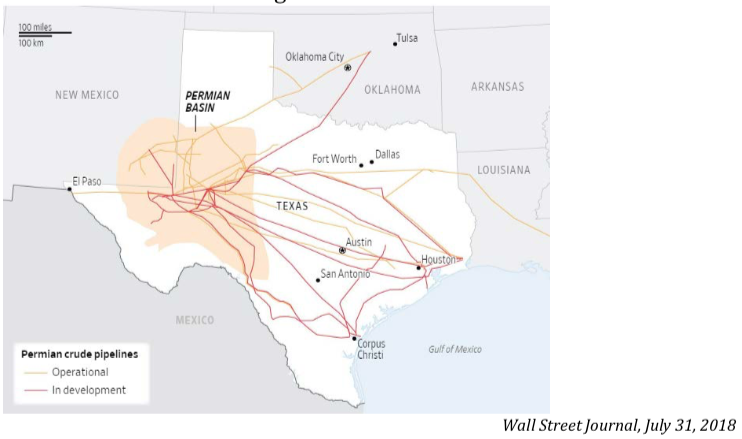
The real growth in domestic production, however, continues to be focused in the Permian Basin, where half of the working rigs are located. As I noted in last month’s newsletter, a potential future take-away shortage might develop as production growth could outpace pipeline take-away capacity. However, we think that even if production in the Permian doubles in five years, take-away capacity should be able to increase to handle the growth in production. This is demonstrated in the map from last month’s newsletter and shown again below:

Another issue has been brought further into the light recently – the large and increasing amount of produced water from the Delaware side of the Permian Basin. The energy industry has long known that the amount of produced water would be a major issue and the key players have made allowances for how to handle it. For those who do not have a plan, it will be a major problem. To demonstrate the scale of what is to come, imagine each well in the Delaware that produces 1000 bbl./day of oil will also produce 5000 bbl./day of water. It is a problem that will reduce profit margins for many producers.

Taking a step back to look at the policy/geopolitical outlook, U.S. policy decisions seem well grounded in both economic and common sense terms. Many positive developments are largely ignored by the press. I see the current hardball approach as aimed not at producing a long term trade war, but as a tactic meant to create a much better world and much more free trade for everyone. Those who deal with a rogue Iran as it is now (an indisputable bad actor for more than a generation) and complain of U.S. interference should imagine how much business they might do with a more reasonable government in place in Iran. This appears to me to be the aim of U. S. policy. Nobody wins a trade war and we do not believe the U.S. wants one. The administration seems to want trade practices that match the modern world. Many of the trade practices put in place after WWII are no longer in the best interest of the U.S. Now allies and enemies alike are facing a very different America.

U. S. markets are optimistic. Energy markets are stable. Stocks are at all-time highs. The U.S. economy is growing well and unemployment is at record lows for all groups of people. In the current economic scenario, we are confident that our energy strategy is the right one for our investors.

Yours Truly,

Dana McGinnis &
Mission Advisors