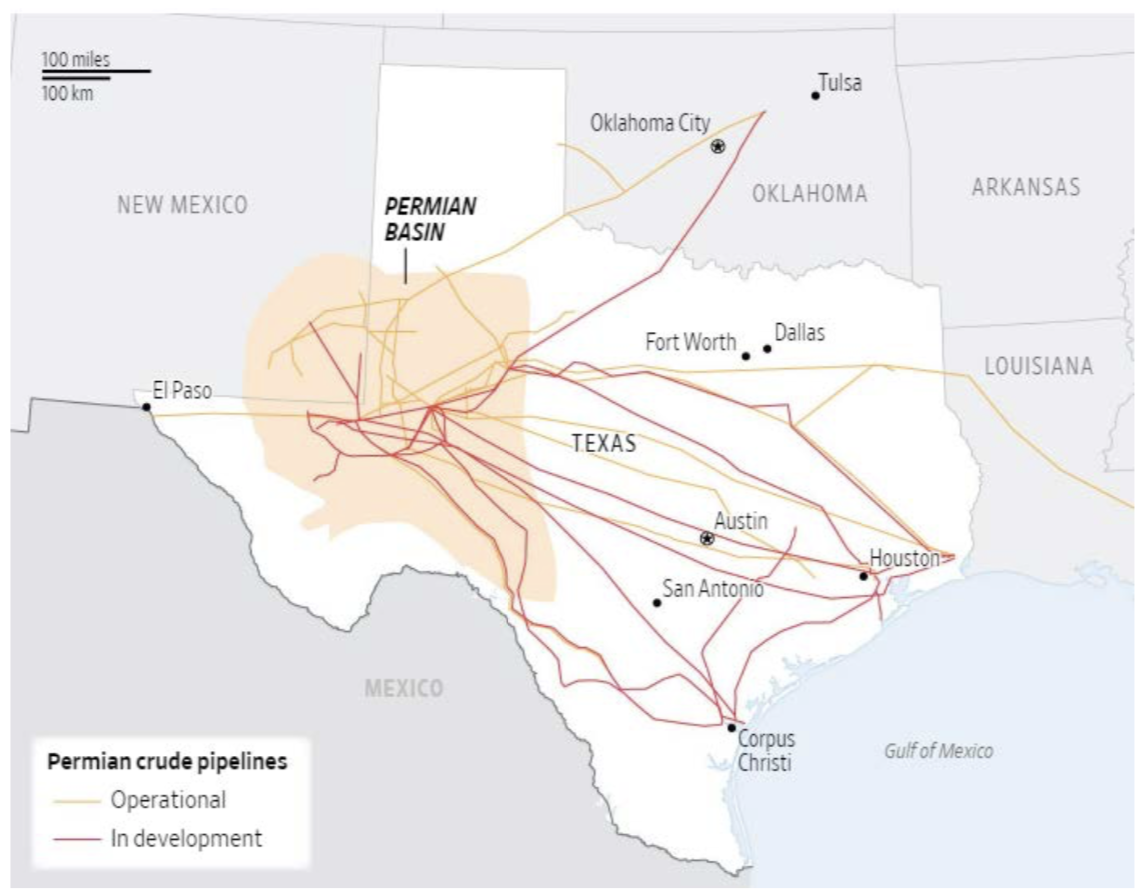
This map shows the number of pipelines that are proposed to be built in the Permian Basin, to handle the expected increase in production in coming years. Bear in mind that the Permian Basin constitutes the largest oilfield in the world now and the proposed capacity increase of these pipelines will double the production rates. While it is true that not all of the pipelines may be constructed, it will still be the largest production increase anywhere in the world, even if only a few of them are built.
The world’s oil supply and demand situation remains complicated – as are global energy politics. The main thing that energy investors need to remember is that large new supplies are coming from the Permian Basin, which will meet new demand (though not necessarily all) and continue to displace high cost producing areas.
The oil markets and our holdings were stronger than expected in June after the big run up in May. Geopolitics and some technical issues get the credit. The U.S. government has re-imposed strict sanctions on Iran over its nuclear program and its support of terrorists groups all over the Middle East. Furthermore, the U.S. has threatened to close the U.S. market and exchange capabilities to any country that does not comply. No country can afford to disregard this threat.
On the technical side, fighting in Libya has limited their ability to export the amount of oil that is expected of them by OPEC. Venezuelan production continues to decline due to the corruption of the government and the lack of capital or foreign exchange to sustain the infrastructure. There was a fire in the tar sands of Canada that will likely take 360,000 barrels of production off the market for the month of July. Lastly, production in the Permian is beginning to outpace take-away capacity and this will soon limit the amount of oil that can reach the market from the area. New pipelines are under construction but constraints will be in place for a year or more.
Taken together, these events have reduced the amount of oil available at the same time that OPEC has reduced production – just when demand is at a seasonal high. Demand is rising in general worldwide on top of these short term current issues so oil prices are going up. It is hard to say how long this situation will last but there are few options that will help bring prices down in the near term.
The fundamentals of the fossil fuel markets for the moment are firm and the geopolitical situation, while tense, is also positive for energy prices.
It is one thing to write about why we select certain holdings for our fund. It is another thing altogether to see our convictions come true in as dramatic a fashion as you have seen this year. I am pleased to have performed well for our partners over the years, particularly during this last month. I will add that the Permian Basin’s dominance driving recent performance is far from over. Currently the Permian produces about 30% of the 10 million barrels of oil the US produces a year. We believe in future years that percentage will rise to almost 50%. The Fund is well positioned with Permian centric assets that we feel should continue to perform.
We do caution partners that there are reasons to expect consolidation of these gains during the next few months, at current levels or even slightly lower, because of take away capacity constraints and labor shortages in West Texas. Major companies are working as hard and as fast as they can to build pipelines and processing capacity to handle current production — and even higher production levels in the future. As these major new capacity additions near completion, we believe our portfolio assets will continue to appreciate.
Please feel free to contact us for further details or with any questions.
The oil markets and the energy business came to life over the last few weeks spurred by steadily falling inventories, continued production restrictions by key OPEC members, and rising tensions over the Iran deal. Most energy indices performed well in April and May is off to a good start.
At the moment, oil prices are around $70 a barrel. As I have said before, we are not in the business of predicting oil prices, but we have had a bullish bias for at least a year. Our optimism is buoyed by many factors including what we see in the global markets as well as the flourishing Permian Basin where we have taken great interest. We remain convinced that the Permian Basin is the place to be if you want to make money in energy.
We all recall the period from 2014-2016, when oil prices dropped dramatically, breaking the 20+ year reign of market manipulation by OPEC. The recovery we are seeing is due to the ingenuity of U.S. free market forces and the expertise of the U.S. energy industry. We have developed the formidable ability to extract massive amounts of oil and gas from shale formations and bring new supplies to market at a profit.
Presently, take-away capacity constraints in the Permian are putting pressure on WTI, which is beginning to sell at a discount to Cushing prices. We believe that as West Texas pipelines come on stream later this year, Permian volumes will begin to put pressure on worldwide prices – and WTI discounts should shrink again.
As for the sanctions on Iran affecting the world energy markets, we think the effect will be minimal except for Iran where they will certainly sting.
We hope all is well with you and encourage you to call us with any questions.
Processing of K-1s has taken longer than expected but we hope to get K-1s out to you ASAP. For the time being, we can supply a rough estimate that there should be little in the way of income or realized capital gains or losses for 2017. We do expect that there will be some depreciation deductions. Overall we are estimating zero in the way of taxable income.
Turning to the market and the portfolio, the Fund had a correction last month. The energy sector and general markets had a much bigger one. Markets across the board are now in a correction, mostly over the tough trade talk coming out of the White House. There have been some tariffs imposed on China but they are still minor and it is rumored that there are behind-the-scene talks to reach a non- confrontational settlement. No one wins a trade war, but the Administration has a point that much of the trade with China and others is too one sided and there are likely ways to improve them.
Passing a tax bill, which was very good, is not enough. The economy is in very good shape now after only a year partially because of the tax cuts, but also because of a series of little talked about rollbacks of burdensome government regulations. These regulatory revisions could help create an even stronger economy and jobs market that could last years and years.
Despite the current market correction, the US energy markets are in pretty good condition. Prices are higher. Most companies have greatly reduced costs and are focused and lean. Prices are not high enough yet for some areas to return to active exploration but activity in the Permian continues. The U.S. is starting to export increasing volumes of petroleum products, helping the world keep prices for energy low. This is a boon to all economies. The Permian has the lowest costs of any area in the world outside the Middle East and is doing extremely well in the current environment. Remember that competitive production from the Middle East has very low cost but is governed by country budgets that need revenues not profits.
Prices around $60 for oil are high enough to be extremely lucrative for Permian operators. They are not high enough to bring much competition from other areas such as the Bakken or the Eagle Ford, or from offshore wells. If OPEC producing countries were to try to increase production in the near future, prices would again decline, in our opinion. This is a beneficial scenario for the U.S. and will likely last until rising Permian production can no longer supply the bulk of slowly rising worldwide demand.
We think the Permian Basin and its producers will continue to rise in prominence and importance. With the portfolio tactically committed to the area, we expect our investors will continue to profit.
The Fund value retreated (-.58%) last month after a fine performance in January. The Alerian MLP Index we have long used for performance comparison declined (-9.69%) in February. The Fund is now up +18% net of fees for the year vs.
(-6.5%) for the index. Our long exposure for most of the month was ~110% and our short position, oil price hedges, running about 10%.
Our key position in Texas Pacific Land Trust was stable but did experience some volatility. Their earnings report for the year was outstanding even though they reported a backlog of drilled but uncompleted wells “DUCs” on their lands. Those DUCs are a source of concern for a number of analysts and for some investors with the thinking being that a large number of future completions will flood the oil market and depress prices. Some of those concerns may be justified because many of the DUCs in the Permian will be completed in the next two years and we do expect them to put some pressure on prices in the short term. Many of the DUCs outside the Permian, however, may not be completed anytime soon, as those in the Marcellus face a shortage of infrastructure and a glut of natural gas from existing wells. Many of the DUCs in other fields in the U.S. will need to see sustained prices above $65-70 before spending money for completions. Not so in the Permian where costs are very low especially compared to production volumes.
Any production bump from DUC completions likely will be short lived because though drilling will proceed in the Permian, worldwide spending to replace natural depletion of existing production is woefully inadequate to meet still rising demand for fossil fuels. We do expect some pressure on prices later this year, but by 2020 there is no other way to meet rising energy demand than to drill for oil and gas. If demand continues growing even the much higher production that we expect form the Permian (much higher than industry estimates) will not be enough to keep oil and gas prices from moving to much higher levels.
The continued rise in the demand for fossil fuels is simply a fact, yet most public reports (outside the energy industry) speak of nothing but alternative energy or the future of electric cars. While the use of alternative energy is rising, and may well even be the future for the world, it is hard to see that occurring when we are not really dealing with the here and now. Almost all publically listed alternative energy companies have gone broke and all of the ones that have survived are subsidized by government. Whether those subsidies come from the U.S. or from China makes no difference when we speak in terms of global energy needs or emissions that dirty our air, it is still a subsidy. Future energy must be cheap enough so that people can afford it and subsidies are not the answer.
It is time that all governments and people start discussing our future energy needs in those terms. The U.S. Congress is beginning to reduce subsidies to the wind and solar industries and both of those groups are in retreat. What makes sense now for a national energy policy is to encourage the use of natural gas and to push for the faster conversion of coal plants to natural gas. Both fuels are abundant but gas emissions are half that of coal. There is no reason to punish coal, just allow economics and strict emissions standards to do the work. We can no longer afford to allow emotional arguments with no factual basis to impede progress.
The U.S. is becoming an energy powerhouse. We should take full advantage of our well- earned energy leadership and profit while helping the rest of the world reduce energy costs. In the meantime, for the Fund, we will continue to do what we have been doing for years, provide positive returns for our investors. In doing so we try to follow the advice of Will Rogers as he said, “Only buy stocks that go up, if they don’t go up don’t buy them.”
We suggested last month that we believed that 2018 would be a strong year for equity markets including those in the energy sector and in our energy portfolio. In January, we were certainly not disappointed as equity markets raced ahead and the portfolio gained 18.7% net of fees. Most of these gains reflected optimism about the general strength of the economy and a massive tax cut delivered from Congress in December. The main beneficiaries of the cuts will be corporations who will see their tax rates decline from 39% to 21% and go a long way to putting US corporations on an equal tax footing with competition around the world (from a tax perspective). We believe the lower tax rates given to most mid-income Americans will add strength to the economy for years to come.
There are potential risks to the rosy economic expectations that we saw in January, those being fears of higher inflation and higher rates as a consequence of larger deficits. Those fears took over in February and knocked the market back down to realistic levels. Fortunately, our portfolio is still up nicely for the year. The gains may have come too quickly, but so did the reversal. We believe the case for higher markets is on firm economic footing and if this proves correct, the market should be reasserting itself soon.
The energy markets, including positions in our portfolio began correcting this month as well, but for the obvious reason that oil prices finally started to fall. The macro background for oil is centered on the production volumes from OPEC and from the Permian Basin of West Texas and New Mexico. In the world of oil, these are crucial areas.=
Oil prices have risen for several months because of OPEC cutbacks, inventory drawdowns, and worldwide increases in demand. The world began to notice recently that oil production from the Permian Basin has risen much more quickly that markets thought possible. We think that this positive surprise will continue from the Permian and that production from the region will be far stronger than estimated now.
As oil production from the US passes ten million barrels a day, the industry is now thinking that US production can be as much as 11 million barrels/day by 2019. We think it could be that high or higher by 2019 and then much higher by 2021-23, all as a result of Permian production. If that does happen, oil prices will come under pressure.
However, even as Permian volumes put pressure on oil prices, Permian volumes will just continue to rise and the Permian producers will capture more and more market share at the expense of producers in the rest of the world.
For exposure to the Permian, we continue to like Texas Pacific Land Trust, Viper Energy Partners, and other select energy companies focused on the Permian.
We want to reemphasize what we said in last month’s letter: we think 2018 will be a good year for energy stocks. Selection will continue to be important and we believe the portfolio is well positioned. It is our intention to update our latest report on Texas Pacific Land Trust, our largest holding. We will discuss the state of the energy business in a longer communication soon. In the meantime we include our last TPL letter and wish everyone a prosperous New Year.